
How Digital Humanities Can Revitalize Language Programs

I recently had the opportunity to talk about digital humanities in the context of new professional horizons, the rise of AI, and the urgent need to rethink language programs across the United States. Digital humanities is the practice of using digital tools to rethink how we consume, create, connect, and share knowledge. It is not about adding technology to existing courses. It is about redesigning learning so students produce meaning for real audiences, work across media, and connect their intellectual work to the world around them.

This matters deeply for language education. As we argued in our Conversation article on AI earbuds and the future of our profession, language learning is far more than a transactional skill. It is one of the most challenging, rewarding, and transformative human endeavors, grounded in identity, relationships, culture, interpretation, and the lived present. Digital humanities allows us to double down on these human dimensions while still embracing the digital reality our students inhabit. It shifts the focus from random input to relevant multimodal sources, from the grammar syllabus to meaningful tasks thoughtfully supported by technology, and from the typical classroom presentation to a product with public relevance.

In a recent reflection on institutional change and uncertainty, I wrote about how moments of disruption force us to ask better questions about what higher education is for. Digital humanities offers one powerful answer. It bridges the need to cultivate critical skills with the need to reconnect the university to society and to new ways of communicating and creating knowledge. When students build Story Maps about local transportation equity, publish blog posts that examine complex global and local issues, or design language games tied to their community, they are not just learning Spanish. They are learning how to observe, interpret, design, and contribute.

This is also where digital humanities becomes a strategic response to declining enrollments in language programs. Students are drawn to relevance. They want to see how their learning connects to real issues, real communities, and real careers. Digital humanities reframes language study as a laboratory for digital communication, intercultural problem solving, and civic engagement. It makes visible the transferable skills that language educators have always cultivated but rarely named in ways that resonate beyond our field.

Berlin Wall at the Newseum
I took this picture at the now-extinct Newseum in Washington, DC. It shows a fragment of the Berlin Wall. It reminds me of the importance of digital humanities in times that call for both walls to be understood and bridges to be built.

Digital humanities, then, is both inward and outward. Inward, it transforms how we select and scaffold input, how we assess learning, and how students understand their own intellectual agency. Outward, it positions the language classroom as a hub of public facing scholarship, community partnership, and digital creativity. In a time when AI can generate text in seconds, what becomes valuable is not only speed, but the ability to pair that speed with depth, meaning, and connection.

If we take this seriously, digital humanities is not an add on to language programs. It is a redefinition of them.
37 Years of CALL

Tailwinds for Critical Innovation in the Language Learning Field

Here is a brief article I wrote for the CASLS Intercom newsletter, released March 2, 2020. Subscribe to Intercom here, a must for language learning professionals.

The winds are favorable for the field of language education, with more than 777 language startups, a single app with more than 300 million users, and an online language learning market projected to grow by 18.61bn in the next four years. We should be suspicious about the commodification of language learning, and the proliferation of deceiving “magic pill” disruptors, but the truth is that none of us work for free as language professionals. What are we doing to make sure these resources are not wasted, positioning ourselves at the helm of our field for formal and informal learners who want to maintain and speak new languages? Higher education enrollments are declining and language learners are not in the business of giving language teachers work.

It is not a coincidence that the Center for Applied Second Language Studies (CASLS) at the University of Oregon asked me to write this piece. They are setting the pace for meaningful collaborations between academia and industry players and together we are planting the seeds of a Community of Practice for strengthened intersections between Instructed Second Language Acquisition, user-experience design, and product development. Millions of users are subscribing to language apps, but they often obtain disappointing results. We understand language development as a wicked humanitarian problem and our goal is to promote transformative tools, spaces, products, and tech jobs that address the complexity of learning a language, in other words, a new way of being in the word.

What I like about CASLS is not different from what I like about many intrapreneurs that I have interviewed in the last 10 years. They are thinkers and doers, critical innovators like that group of instructors at Princeton who created their own Spanish textbook, breaking up with an industry that benefits from a broken market. When I talked to them, I felt agency, a special and contagious energy such as the one that Joan Bajorek infuses in Women in Voice. Joan left a promising career in academia for a job in the tech industry and is now a role model for any applied linguist who is not seduced by the tenure-track path. And back to higher ed, recently two language professors at Yale started a course entitled Languages in Dialogue, blending Arabic and Hebrew. As challenging as it seems, one can only hope to see more multilingual initiatives such as this one, since the world outside of the classroom is rarely monolingual.

We face, indeed, a time for the language field to reconsider its relationship with innovation. The winds are more favorable than we think. 

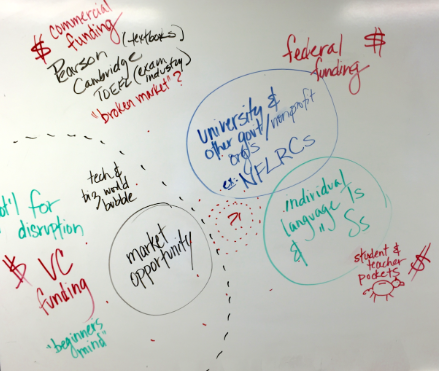
Sarah Springer made this graph, as a result of a conversation we had for our CALICO 2016 presentation Wands, Spells, and Magic Pills: The Lingo of Language Learning Products

Gabriel Guillen (PhD) is a Professor and the Director of the Summer Intensive Language Program at the Middlebury Institute of International Studies (MIIS). At MIIS, Gabriel teaches content-based language courses such as Spanish Social Entrepreneurship, Spanish Fake News, Spanish Digital Projects, Spanish Talks for Social Change, and Spanish in the Community, connecting his students with English learners in the Salinas Valley, California. With Robert Blake, he recently published Brave New Digital Classroom (2020), an overview on key concepts and challenges of teaching and learning languages with technology, with a new focus on social CALL (Computer-Assisted Language Learning). With Julie Sykes and Christopher Daradics from CASLS, and Thor Sawin from MIIS, Gabriel will be hosting the panel Mavericks of Mind: A Followup Report on Social CALL for Language and Technology Professionals at CALICO 2020


Digital Storytelling Tools

Here are some free and partially free tools for telling your story. Use this site to add new sites or access direct links.

WP-Backgrounds Lite by InoPlugs Web Design and Juwelier Schönmann 1010 Wien