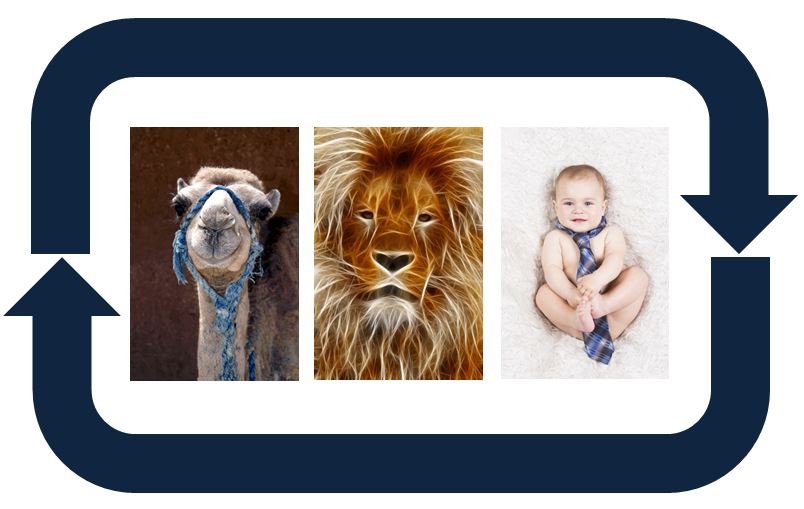
A Professional Metamorphosis

Camel_Lion_Child
What kind of professional are you? A camel who asks what do I need to do? A lion who asks why do I need to do it? A child who wants to do it differently?  

Close access to intellectual stimulation is one of many perks of being in academia. Last March I attended a workshop lead by my Language Studies (LS) colleague Michel Gueldry  on “Integrating one’s personality by seeing what we don’t see,” as part of a series of workshops organized by another LS colleague, Jinhuei Dai.

Michel focused on self-observation and emotional intelligence by using, among other provocations, a parable by Friedich Nietzche, The 3 Metamorphosis of the Spirit, from Thus Spake Zarathustra.

Our discussion was so fertile that months later I still find myself going back to the three images of the spirit and re-purposing the metaphor.  You don’t have to agree with Nietzsche’s teleology (from camels to lions and from lions to the child) to recognize the clear-sighted, evocative power of his writing.

“A child is innocence and forgetting, a new beginning, a game, a wheel that propels itself, a first movement, a sacred Yes.  Yes, for the game of creating”.

Thus, I shared this parable with some colleagues who are participating in a series of conversations about transformative practice, teaching, and learning. What kind of professionals do we want to see graduating from our institutions? Camels? Lions? Children?

It’s easy to see the child as the entrepreneur, the creative type… A sacred yes! It’s sometimes the outsider with innovative ideas, the creator of disruptive solutions, prototypes, products and sometimes problems… But new problems. The child doesn’t understand or doesn’t care about the criticism, the destructive energy of the lion.

And the lion makes fun of the naïve kid. The lion fights imposed values, status quos, establishments, traditions, old habits… A sacred no! The lion is particularly cozy in the cages of academia but you can find them anywhere, fighting real or imaginary dragons. In the best scenario, they challenge our superficial ideas and make us better thinkers and doers.

The camel doesn’t get much credit. They are the comic butt of arrogant children. They are not always respected by the lion. And yet, we also need to think and act like camels. Yes. And by yes I mean no. No to Nietzsche! Kneeling down like the humble camel, accepting the existence of other values, traditions, practices and recognizing our own cultural burden…  All of this is important, particularly in the academic context.

See the dromedary as the fast doer (camels are fast), willing to go the extra mile, able to store knowledge, able to make water from fat! In the worst scenario, camels get into professional traps, vicious circles, alienation, bulling, lacking the verbal muscle, the claws of the lion or the slippery skills of the child.

We all need to be camels, lions, and children. Competent, critical, and creative. The question is when and how. And how much. The answer should emerge from your own multiple experiences, values, goals, needs, adapting, blending with others,  being curious, creating realities with the transformative stick of languages, ideas, methods, technologies, swimming  furiously, making noise, scaring the sharks, going against the current… at the right time.

Are you the young fish asking what the hell is water? Are you the ape, the Vygotskian ape, sharpening your magic wands, interacting and learning from your peers? Are you a chameleon, a multilingual, multilayered professional, a blend of Malala Yousafzai, Noam Chomsky, Warren Buffet, Melinda Gates, MacGyver, and a Lonely Planet writer?

Can you do well and do good? I want to say yes. Others disagree.

Consejos para escribir más claro

¿Qué libros recomiendas a estudiantes que quieren o necesitan mejorar su escritura? Después de unos cuantos años, yo sigo recomendando La cocina de la escritura, de Daniel Cassany. Aquí te dejo con algunas de sus ideas y consejos. ¡Comparte los tuyos!

Ojo, son fragmentos de la edición de 1996 y me he tomado la libertad de titularlos.

Continue reading Consejos para escribir más claro

Soccer and language learning

“After many years in which the world has afforded me many experiences, what I know most surely in the long run about morality and obligations, I owe to football.”  (Albert Camus)

I have been using the metaphor of soccer for language learning for a while now, trying to express its collective nature, its complexity, its embodiment, and its unpredictability.

Yes, I know. It would be easier to think about it as going to the gym. We do need consistence. Goals. Repetition. And we benefit from coaching, recommendations, feedback.

However, language is not an individual sport. Nor a rigid set of rules, as Leo van Lier reminded us with great eloquence:

“I remember a visiting jazz musician speaking to my son’s music class in high school. I was outside in the hall (eavesdropping), waiting to pick up my contingent of car pool victims. The musician (a rather well known professional jazz performer) was just finishing his demo with some final words of wisdom. He said that students should think of music as a creative exploration, something that just flows. He felt that the students thought of music more as a rigid set of rules and formulas that had to be learned by heart, “just like mathematics and foreign languages. ” This was a quite interesting comment. Why should foreign language learning be equated with mathematics, rather than with, say, painting, or music, or soccer? After all, as I argued in the last chapter, language use requires an investment of voice, and there is an aesthetic element in language use from this perspective, in the same way that voice and identity are invested in music, painting, and even in more bodily activities such as soccer (and of course dance).”

Like soccer, language learning is based on unpredictable human interactions. It requires creativity, tolerance of ambiguity, certain kind of empathy, critical thinking…

The successful language learner has played many games and learned from them, creating a persona, an ethos, a pathos in the field, knowing how and when to pass the ball, to dribble, and to improvise.

They have practiced improvisation and yes, “not improvising in the all-too-common and incomplete sense of just making stuff up and saying anything.”

An agency-promoting curriculum

Too bad I didn’t get to meet Leo van Lier, soul of our Institute:

“A completely passive learner will not learn. A compliant (obedient, dutiful etc.) learner will learn, because he or she employs agency, if only at the behest of others. In this way learners who study a foreign language in school because it is required, will be able to have some success and to pass tests. However, in order to make significant progress, and to make enduring strides in terms of setting objectives, pursuing goals and moving towards lifelong learning, learners need to make choices and employ agency in more self-directed ways. In addition to autonomy and related characteristics, agency is also closely connected to identity, and this emphasizes the social and dialogical side of agency: it depends not only on the individual, but also on the environment. In the classroom, an agency-promoting curriculum can awaken learners’ agency through the provision of choices and the opportunity to work as a member of a learning community on interesting and challenging projects and puzzles (Allwright & Hanks, 2009)”.

Leo van Lier (2010, p. 5)

WP-Backgrounds Lite by InoPlugs Web Design and Juwelier Schönmann 1010 Wien